Custom Wholesale Satin Jackets Engineered to Scale
Tech-pack to full container load. GRS-certified satin fabrics, high-density chenille patches, zero seam puckering, and flexible MOQs across 9 production hubs worldwide.
DDP, FOB, or EXW shipments with consolidated air and ocean logistics lines.
Capital-Friendly MOQ
Start small per colorway, validate sell-through, and scale seamlessly into container orders.
Deep Satin Library
210T to 300T poly-satin, nylon-satin, duchesse, and rPET sustainable weaves ready for sampling.
Dedicated Merchandiser
One direct contact for fabric lab-dips, embroidery digitizing, and AQL 2.5 final inspections.
B2B Sourcing Intelligence
The Global Buyer’s Engineering Guide to Wholesale Satin Jackets: Sourcing High-Margin Bomber, Varsity, and Retro Outerwear with Technical Precision
Navigating the B2B procurement of wholesale satin jackets requires more than aesthetic appraisal. From preventing needle-hole tearing on high-luster 300T weave shells to resolving seam puckering along curved armholes, this guide delivers technical insight, supply chain transparency, and market intelligence for retail buyers, private label founders, and corporate merchandise procurement directors.
In the competitive global outerwear market, the term "Wholesale Satin Jackets" encompasses a broad spectrum of technical apparel—ranging from lightweight 210T polyester snap-front athletic warm-up jackets to heavy 280 GSM duchesse satin luxury bombers and vintage retro varsity silhouettes. For professional procurement teams, securing high sell-through margins requires a deep understanding of textile physics, surface tension treatments, embroidery stabilization, and supply chain scalability. Oasis Jackets, operating as a core manufacturing unit of the Dioz Group with over 16 years of OEM/ODM expertise across 9 production countries, engineers custom satin jackets that balance visual luster with structural longevity.
Recommended Fabric Density
210T – 300T Filament Weave
Seam Puckering Threshold
< 0.5mm Dialed Tension
Color Fastness Standard
Grade 4-5 (ISO 105-B02)
1. Fabric Weave Dynamics: Selecting the Correct Satin Substrate for Bulk Orders
Satin is not a fiber; it is a weave structure characterized by floating warp or weft yarns that create a smooth, reflective surface sheen. When sourcing wholesale satin jackets, buyers must specify the precise fiber composition and thread density to align with end-use durability requirements:
High-Density Polyester Satin (210T–300T): The industry standard for streetwear and sportswear bombers. Offers high tensile strength (warp strength > 800N), wrinkle resistance, and excellent color retention during sublimation or piece-dyeing. Weight ranges from 110 GSM for light wind-shells to 180 GSM for classic varsity builds.
Nylon Satin (High-Luster Technical Shells): Preferred for retro athletic jackets and souvenir (Sukajan) jackets. Nylon satin provides superior abrasion resistance, a fluid drape, and a rich deep-gloss finish, though it requires specialized low-temperature needle control during stitching to avoid heat-friction filament melting.
Heavy Duchesse Satin (220–280 GSM): A heavy, crisp satin with a high thread count and rich structure. Ideal for high-end luxury fashion brands requiring structured shoulders, voluminous oversized fits, and zero transparency under direct lighting.
GRS-Certified Recycled Satin (rPET): Produced from post-consumer PET bottles, delivering identical tensile performance and luster while providing full supply chain traceability via Global Recycled Standard transaction certificates.
2. Engineering Seam Integrity and Overcoming Common Satin Manufacturing Defect Rates
The single greatest failure point in low-cost bulk satin jacket production is seam puckering and yarn slippage. Because satin filaments glide over one another easily, improper sewing needle selection or miscalibrated thread tension leads to visible seam wrinkling, thread pulling, and fraying along stress seams (e.g., underarms, shoulder joins, pocket welts).
At Oasis Jackets, our production facilities eliminate seam failure through four mandatory technical controls:
Calibrated Ballpoint Needles (70/10 to 80/12): We mandate fine round-point needles that part the delicate satin warp threads without piercing or severing individual filaments. Needles are replaced every 4 hours of continuous production.
Micro-Textured Core-Spun Polyester Thread: We utilize high-tenacity, low-shrinkage core-spun polyester thread with elastic elongation properties that match the mechanical stretch of the satin fabric under movement stress.
Fusible Non-Woven Interlining at Stress Points: Pocket entries, snap-button plackets, collar joins, and zip tapes are reinforced on the reverse side with ultra-light (25 GSM) non-woven fusible interfacing to distribute shear stress evenly.
Differential Feed Dog Mechanics: Computerized sewing machines are programmed with negative lower-feed differential ratios to pull the bottom satin layer at the exact speed as the top layer, completely preventing feed-wave puckering.
B2B Core Silhouettes
Wholesale Satin Jackets: Top Recommended Categories
Select from our pre-engineered, factory-tested base patterns. Each satin jacket silhouette comes fully graded from XS to 5XL with customized lining, ribbing, and hardware choices designed to streamline lead times by up to 35%.
Best Seller
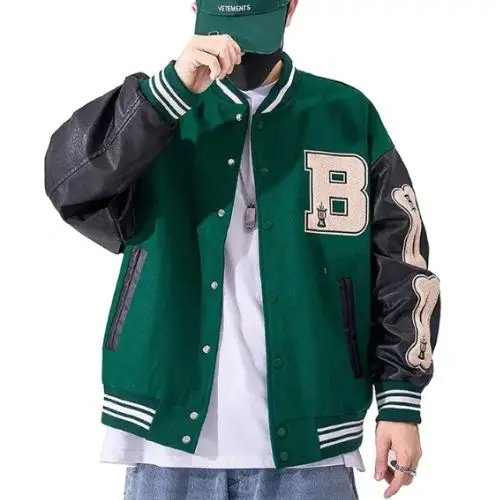
Retro Satin Varsity Jackets
Heavyweight 220T poly-satin shell with custom 2x2 cotton-acrylic yarn-dyed striped ribbing, heavy-duty brass snap closures, and high-density 3D chenille patches.
Intricate multi-thread direct back and chest embroidery (up to 150,000 stitch count) on high-sheen reversible satin shell with raglan sleeve construction.
The Craftsmanship, Heritage, and Technical Evolution of Satin Outerwear
To design high-selling satin jacket collections today, it is essential to understand the structural evolution of satin in apparel manufacturing. Originally reserved for 1950s American collegiate warming jackets and post-war Japanese Souvenir (Sukajan) jackets, satin has transitioned from niche athletic workwear into a staple of modern streetwear, luxury fashion, and corporate team merchandise.
From 1950s Athletic Sideline Jackets to Luxury Streetwear Icons
Mid-20th-century satin jackets relied on heavy cotton-backed rayon satin, which offered high sheen but suffered from dry-cleaning degradation, water staining, and poor moisture management. As synthetic fiber extrusion advanced, 210T polyester and nylon filaments replaced rayon, giving birth to the iconic 1980s MLB snap-front satin jacket era—celebrated for vibrant color pop and lightweight weather shielding.
Today’s fashion landscape fuses vintage nostalgia with technical performance. Contemporary luxury brands demand heavyweight duchesse satin weaves, matte-finish micro-satin shells, and waterproof-breathable laminated membranes (5,000mm hydrostatic head / 5,000g/m²/24h breathability) that allow satin jackets to withstand heavy rainfall while retaining their signature luster.
Decorating smooth satin shell fabric requires specialized backing stabilizers. Applying heavy embroidery directly onto thin satin causes distortion, yarn tearing, and fabric pulling around the graphic border. Oasis Jackets overcomes this through:
Zero-Tension Frame Hooping: Pneumatic hooping stations ensure uniform shell tension without stretching the warp filaments before embroidery heads strike.
Tear-Away Non-Woven Stabilizer Backing: Dual-layer 80 GSM backing stabilizes the stitch bed, preventing fabric bunching during 100,000+ stitch count back designs.
3D Felt-Base Chenille Patches: Patches are embroidered onto wool felt sub-layers prior to heat-press tacking and border-stitch application, eliminating direct shell stress.
Strategic Sourcing Insights
Future Procurement Trends in Wholesale Satin Jackets (2025–2030)
Anticipate market shifts, regulatory requirements, and material innovations to keep your apparel brand ahead of global competitor supply chains.
01 · GRS-Certified Closed-Loop Recycled Satin
Global apparel buyers are phasing out virgin polyester satin in favor of post-consumer rPET yarns. Future-proof your sourcing with verified GRS Transaction Certificates and OEKO-TEX Standard 100 chemical safety compliance.
02 · PFC-Free Bio-Based DWR Surface Treatments
As EU and US regulations ban perfluorinated chemicals (PFAS), modern satin jackets require C0 bio-based Durable Water Repellent finishes that provide hydrophobic water beading without compromising fabric softness or gloss.
Exterior satin shell minimalism is paired with bold interior art prints. Utilizing digital sublimation on 190T poly-satin linings allows brands to showcase intricate graphic storytelling without altering exterior stitch lines.
Factory Floor Quality Standards
How We Manufacture Wholesale Satin Jackets with Zero Defect Rates
Outerwear procurement demands absolute consistency from carton #1 to carton #1,000. Here is how our 4-stage quality control protocol guarantees flawless bulk production.
Stage 01
4-Point Fabric Audit
Every roll of satin fabric is inspected under D65 standard light boxes for snagging, shade variation, filament pulls, and GSM tolerance prior to cutting approval.
Stage 02
Precision CAD Cutting & Fusing
Computer-controlled laser and vacuum cutting tables prevent fraying along bias cuts. Non-woven interlinings are thermal-fused to plackets and collar beds.
Stage 03
Tension-Controlled Assembly
Dedicated outerwear lines equipped with ballpoint needles assemble shells, lining, and ribbing with under-arm seam tape reinforcement.
Stage 04
Steam Pressing & AQL 2.5 Audit
Form-fitting steam pressing shapes the collar and cuffs. Every garment passes metal detection and strict AQL 2.5 final random sampling before export packaging.
01
Lab-Dip Approval
Spectrophotometer color matching to target Pantone (PMS) with 3-light source verification.
02
Trim Pull-Testing
Snap button pull-strength tested to > 90N to meet international safety standards.
03
Inline Stitch Audit
Hourly checks for stitch density (12–14 stitches per inch) and seam symmetry.
04
Sealed PP Sample
Bulk production is locked strictly against your signed pre-production reference sample.
Enterprise Manufacturing Excellence
Why Global Brands Partner with Oasis Jackets for Wholesale Satin Outerwear
With 16+ years of specialized outerwear production experience, 9 country production hubs, and direct sales offices across the US, UK, UAE, Australia, Germany, France, Brazil, Qatar, and Saudi Arabia, we de-risk international apparel sourcing.
01 · Turnkey Private Label Customization
We provide full white-label and private label production. From custom-woven neck labels, FTC/EU compliant care labels, custom branded zipper pulls, and laser-etched snap buttons to custom hangtags and polybags, your brand identity remains 100% front and center.
02 · Audit-Ready Ethical & Technical Compliance
Our production facilities maintain amfori BSCI, ISO 9001, GRS, OEKO-TEX Standard 100, GOTS, Bureau Veritas, and Higg Index certifications. We regularly pass stringent compliance audits for world-class sports federations, government institutions, and global retail chains.
Production Capacity Snapshot
Global Reach, Unmatched Manufacturing Scale
Industry Leadership16+ Years
Global Sales Offices7 Countries
Manufacturing Facilities9 Countries
Export Destinations55+ Countries
Developed Styles10,000+
B2B Clients5,000+
Merchandising Team100+ Staff
Factory Workforce2,000+ Staff
Enterprise Trust
Institutional Clients & Global Brands We Produce For
Audited Compliance
Third-Party International Standards & Factory Certifications
Local Merchandising Support
Global Operational Desk, Localized Account Management
Our regional offices manage sample approval, tech-pack translation, customs compliance, and logistics tracking in your local time zone.
United States · HQ
8730 Wilshire Blvd, Penthouse, Beverly Hills, CA 90210
Direct technical answers addressing global buyer inquiries regarding fabric specs, customization techniques, minimum order quantities, and international trade compliance.
What fabric specs and density are ideal for premium wholesale satin jackets?
For high-margin commercial retail and sportswear collections, we recommend specifying 210T to 300T high-density woven satin with a fabric weight between 140 GSM and 240 GSM. Lower density satins (<190T) are susceptible to yarn slippage and seam tearing, whereas 300T duchesse or nylon satin provides a rich, silky hand-feel, structural firmness, and exceptional luster. For sustainable product lines, we supply GRS-certified 100% recycled polyester satin made from post-consumer PET flakes.
What is your minimum order quantity (MOQ) for custom private label satin jackets?
Our MOQ is structured flexibly to support both emerging brands and global retail accounts. Styles utilizing our in-stock mill colorways with custom embroidery, chenille patches, or screen printing start at low minimums per style/colorway. For custom mill-dyed PMS Pantone colors, custom-knitted yarn-dyed ribbing, or bespoke jacquard linings, MOQs are set based on fabric mill dyeing thresholds to guarantee maximum cost-efficiency per unit.
How do you prevent seam puckering and needle tears during satin jacket assembly?
Satin is a delicate filament weave vulnerable to puckering and thread pulling. We eliminate production defects by using ultra-fine round-point ballpoint needles (70/10 to 80/12), micro-textured core-spun polyester thread, and calibrated differential feed mechanics on specialized sewing machinery. Critical stress zones—such as armholes, pocket openings, and plackets—are fused with lightweight non-woven interfacing to absorb shear stress without affecting fabric drape.
Can satin jackets receive custom 3D chenille patches and heavy embroidery?
Yes. However, applying high-density embroidery directly onto unreinforced satin shell fabric can cause severe puckering. We utilize a two-step stabilization process: multi-thread embroidery and chenille patches are stitched onto heavy felt or twill sub-bases, which are then fused and perimeter-stitched onto the jacket shell using pneumatic frame hooping to maintain zero fabric distortion.
What branding elements are included under your private label service?
Our private label service is fully white-glove: custom woven main neck labels, printed care & content labels fully compliant with US FTC and EU textile regulations, custom hangtags with barcoding, embossed snap buttons, branded zipper pullers, custom silicone sleeve badges, and branded polybag packaging. No Oasis Jackets branding appears anywhere on your product or export cartons.
What are the lead times for proto sampling and bulk production?
Initial pattern making, digitizing, and pre-production proto sampling require 7 to 12 days. Bulk manufacturing typically requires 25 to 45 days following sealed PP sample approval, depending on order volume and decoration complexity. Express air freight requires 5 to 9 days, while ocean freight takes 20 to 40 days based on destination port.
Do you offer certified sustainable and recycled satin options?
Yes. We offer 100% GRS-certified recycled polyester satin shells and linings. Each shipment is accompanied by Global Recycled Standard (GRS) Transaction Certificates (TC) and OEKO-TEX Standard 100 chemical test reports to ensure your brand's green marketing claims are 100% legally defensible.
What international trade and delivery terms (Incoterms) do you support?
We handle orders under DDP (Delivered Duty Paid), FOB (Free on Board), or EXW (Ex Works) terms. For buyers operating without internal import departments, our DDP service handles all customs clearance, import duties, tariffs, and door delivery directly to your distribution center.
Dedicated Satin Merchandising Desk
Launch Your Private Label Wholesale Satin Jacket Line Today
Send your tech pack, vector artwork, or sample garment reference. Receive a comprehensive manufacturing proposal, fabric lab dips, and volume price breaks within 24 hours.