Executive Whitepaper: Strategic Technical Procurement in Custom OEM Outerwear & Corporate Apparel
In the rapidly transforming global apparel supply chain, corporate sourcing executives, retail fashion brands, and private label enterprise procurement directors face unprecedented volatility. Procuring custom technical outerwear, corporate uniforms, and promotional merchandise is no longer merely a transaction driven by unit cost. It requires a comprehensive risk mitigation framework, precise material science engineering, verified environmental compliance, and multi-hub operational agility.
Core Procurement Takeaway: Sourcing low-defect corporate outerwear demands shifting from legacy spot-market purchasing to technical OEM/ODM co-development. Specifying hydrostatic head ratings, SAM/SMV metrics, GRS-certified polymers, and seam sealing protocols prior to bulk commitment reduces total cost of quality (COQ) by up to 28%.
1. The Macro Architecture of Modern Apparel Sourcing & Risk Mitigation
Global supply chain bottlenecks over recent years have proven that reliance on a single manufacturing geography creates severe structural vulnerability. Modern procurement models emphasize multi-country manufacturing footprints (the "China Plus N" strategy), nearshoring capabilities, and factory-direct visibility. OEMs operating integrated facilities across regions like East Asia, Southeast Asia, and Central Europe offer brands distinct customs and tariff advantages, optimizing duty structures under trade frameworks such as USMCA, EUR.1, and RCEP.
Furthermore, true enterprise OEM export partners operate beyond simple cut-make-trim (CMT) paradigms. Full-service Original Equipment Manufacturers deliver end-to-end supply chain integration: raw material verticality, mill-direct fabric development, CAD pattern grading, tech-pack reconciliation, localized compliance validation, and door-to-door Duty-Delivered-Paid (DDP) logistics handling.
2. Material Science & Outerwear Technical Engineering
Outerwear is the most technically complex category in softlines manufacturing. A single technical jacket can comprise up to 45 individual components, including face fabrics, laminated hydrophobic or hydrophilic membranes, thermal insulation barriers, internal linings, specialized zipper tapes, seam sealing tapes, cord locks, and structural interlinings. Failure in any single component compromises the structural integrity of the entire garment.
A. Membrane Technology & Hydrostatic Ratings
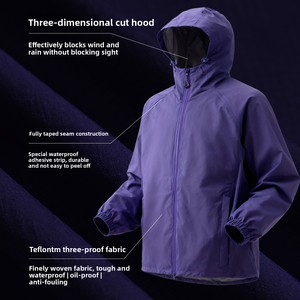
For technical rainwear, softshells, and ski apparel, weatherproofing performance relies on the membrane interface. We engineer 2-layer (2L), 2.5-layer, and 3-layer (3L) laminated structures according to strict laboratory testing standards (ISO 811 / AATCC 127 for water resistance; JIS L1099 B1 / ASTM E96 for moisture vapor permeability):
| Performance Tier |
Hydrostatic Head (Waterproof) |
Breathability Rating (MVTR) |
Ideal Application |
| Urban / Corporate Casual |
3,000 mm – 5,000 mm |
3,000 g/m²/24h |
Light rain, executive windbreakers, corporate promotional outerwear |
| Performance Workwear |
10,000 mm – 15,000 mm |
8,000 – 10,000 g/m²/24h |
All-weather field operations, logistics workwear, active sports |
| Extreme Technical / Ski |
20,000 mm+ |
15,000 – 20,000 g/m²/24h |
Alpine winterwear, heavy outdoor equipment, extreme weather gear |
B. Thermal Insulation Mapping & Fill Dynamics
Thermal mapping optimizes insulation density based on human body heat retention zones. Synthetic insulations—such as recycled polyester microfibers—are mapped in gram-per-square-meter (GSM) weights ranging from 60 GSM in sleeve panels to 200 GSM in core chest chambers. Down outerwear uses responsibly sourced natural down certified under the Responsible Down Standard (RDS) or IDFL, evaluated by Fill Power (FP): 600 FP for volume production up to 800+ FP for ultra-lightweight luxury thermal jackets.
C. Seam Sealing & Ultrasonic Bonding
Stitching creates thousands of needle punctures in shell fabrics. True waterproof construction requires hot-air seam sealing using 2-layer or 3-layer PU/TPU tapes applied at controlled temperatures (350°C–420°C) and pressures. Ultrasonic stitchless welding eliminates needle holes entirely, fusing synthetic panels for sleek aesthetics and absolute water impermeability in modern quiet-luxury technical silhouettes.
3. Quality Assurance Standards: SAM, AQL, and Inline Audits
Consistency across high-volume OEM orders requires rigid industrial engineering and quality management controls. Quality is engineered into the line before mass cutting begins.
Standard Allowed Minutes (SAM) & SMV Efficiency
Industrial garment production uses Standard Allowed Minutes (SAM) or Standard Minute Value (SMV) calculations to quantify labor content. By benchmarking each sewing operation—from pocket-welt construction to collar setting—assembly line balancing avoids bottle-necks, ensuring stable output and predictable unit costing. A classic bomber jacket averages 28 to 36 SAM, whereas a complex 3-in-1 technical parka can reach 68 to 85 SAM.
Acceptable Quality Limit (AQL 1.5 / 2.5) Protocols
Bulk shipments undergo rigorous sampling inspection based on ISO 2859-1 (ANSI/ASQ Z1.4). We enforce standard AQL 2.5 for general commercial lines and strict AQL 1.5 for critical corporate accounts. Every order undergoes four mandatory inspection stages:
- 1. Raw Material Incoming Inspection (4-Point System): Fabric rolls are evaluated for color shade variation, skewing, pilling, and defects per 100 square yards prior to spreading.
- 2. Inline QC Inspections: Hourly roaming auditors check stitch density (SPI - Stitches Per Inch, typically set at 10–12 SPI), seam puckering, seam allowance tension, and symmetry.
- 3. 100% Metal & Needle Detection: All padded and lined garments pass through calibrated conveyor needle detectors to ensure zero broken needle fragments remain inside.
- 4. Pre-Shipment Final Random Inspection (FRI): Packaging integrity, carton drop tests, barcode readability, size spec measurements, and functional trim audits.
4. Industry Trends: Future Sourcing Directions for Corporate Apparel (2025–2030)
Corporate procurement is shifting away from low-quality disposable promotional wear toward premium, durable, retail-quality branded outerwear. Key structural trends defining the next decade include:
Trend 1: Quiet Luxury & Minimalist Branding
Enterprise clients are abandoning oversized screens and loud logos in favor of subtle, high-end branding. Modern corporate apparel highlights clean silhouettes, tonal embroidery, debossed leather patches, matte metal hardware, and covert internal branding. Employees actively wear these garments outside work, vastly expanding brand impression lifecycles.
Trend 2: Circular Economy & Digital Product Passports (DPP)
With upcoming European Union Eco-design for Sustainable Products Regulations (ESPR), traceability is becoming mandatory. Leading OEM exporters integrate Digital Product Passports—using woven QR tags or NFC chips—allowing end-users to verify post-consumer recycled PET content (GRS certified), carbon footprint data, and end-of-life garment recycling instructions.
Trend 3: Smart Outerwear & Heated Wearable Tech
Cold-weather workwear increasingly incorporates integrated carbon-fiber heating panels powered by slim 5V/7.4V USB power banks. OEM manufacturers with specialized electronic assembly lines integrate waterproof wiring harnesses, soft silicone touch controllers, and safety shut-off microchips directly into lined softshell jackets and winter bodywarmers.