0%

Finding the right China supplier for Bulk Down Jackets requires more than comparing factory prices. Quality appears in small details: even quilting, secure zipper stitching, clean finishing, and consistent filling across every size. A jacket may look warm in a product photo, yet perform poorly when the down shifts inside its channels.

This guide examines leading Chinese manufacturers and sourcing partners through practical purchasing criteria. We consider down fill power, fill weight, fabric performance, sample accuracy, production capacity, and inspection procedures. We also review certifications, traceable material policies, communication standards, and export experience. These points help buyers reduce surprises before placing a large order.

Experience matters here. A supplier that produces thousands of jackets may still struggle with a new design, unusual color, or tight delivery schedule. Sample testing can reveal cold spots, loose threads, inaccurate measurements, and unpleasant odors. Do not rely on promises alone. Request test reports, factory evidence, and clear production terms.

The ranking is not absolute.

Markets change. Supplier capabilities change too.

Some factories may excel in premium goose-down jackets, while others offer stronger value for promotional outerwear. This article therefore focuses on fit, reliability, and verifiable performance rather than attractive claims. Buyers should confirm current certifications and specifications independently, because an old catalog cannot represent today’s production line. With careful comparison, businesses can identify dependable Bulk Down Jackets suppliers and build a more transparent, practical sourcing strategy.

What Are the Top China Bulk Down Jackets Suppliers?

China’s Bulk Down Jacket Manufacturing Landscape

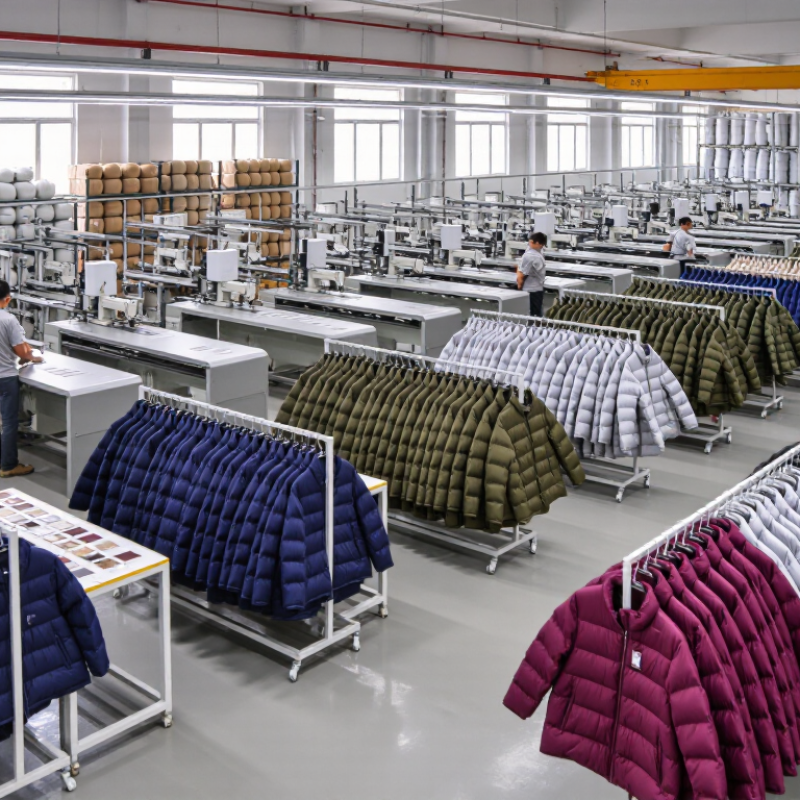
China’s bulk down jacket manufacturing landscape is broad, specialized, and highly regional. Export-oriented factories often cluster around Zhejiang, Jiangsu, Guangdong, and Shandong. Some focus on lightweight urban jackets. Others produce workwear, ski apparel, or children’s outerwear. China Customs data, compiled through ITC Trade Map, shows China remains a major exporter of HS 6201 and 6202 outerwear. Export values reached billions of U.S. dollars in 2023. That scale supports competitive production, but it does not guarantee consistent quality.

Material selection deserves close attention. Textile Exchange’s 2024 Materials Market Report states that polyester represented about 59% of global fiber production in 2023. Many factories therefore offer recycled or conventional polyester shells. Buyers should request fiber certificates, fabric test results, and documented down sources. The International Down and Feather Bureau’s testing framework highlights fill power, composition, and cleanliness. These details affect warmth, weight, and customer returns. Small differences matter.

The strongest suppliers usually provide in-house pattern development, sample rooms, quilting equipment, and final inspection. Ask for measured fill power, not only marketing language. Review shrinkage, colorfastness, zipper strength, and needle-hole resistance. A factory tour helps, but it is not proof. I would still compare production samples with inspection reports. Low pricing can hide weak down recovery or unstable sizing. That lesson is easy to miss. Seasonal capacity also matters, because winter orders can compress production schedules and reduce corrective time.

Key Criteria for Evaluating Chinese Down Jacket Suppliers

A dependable China bulk down jacket supplier should be judged beyond price and product photos. Check factory experience, monthly capacity, sewing quality, and down sourcing records. The Responsible Down Standard requires traceability from farm to finished product, while ISO 9001 can indicate structured quality control. However, certification alone does not guarantee consistent shipments.

Textile Exchange’s 2024 Materials Market Report estimated global fiber production at 132 million tonnes in 2023. This figure shows the scale of textile demand and the pressure on supply chains.

For down jackets, request recent laboratory reports for fill power, composition, cleanliness, and moisture content. Ask whether testing covers every production batch.

China’s inspection and quarantine records, factory audit reports, and buyer references can add useful evidence. Still, a spreadsheet may hide weak stitching or uneven filling. Physical samples matter.

Tips: Compare at least three suppliers using the same scorecard. Review a production sample after washing, compression, and repeated handling. Check carton strength and labeling before shipment. Clarify replacement terms for defective units. A low quotation may reflect lower fill weight, not better efficiency. In my view, the best supplier is not always the largest; it is the one that explains risks clearly and documents corrective action. That judgment can be imperfect, so keep testing.

(Sources: Textile Exchange, 2024 Materials Market Report; Responsible Down Standard, current requirements.)

Leading Supplier Categories and Their Product Strengths

What Are the Top China Bulk Down Jackets Suppliers?

China’s bulk down jacket suppliers usually fall into three categories: factory-direct manufacturers, trading companies, and specialized down garment producers. Factory-direct suppliers often provide stronger cost control and flexible production planning. They can adjust shell fabric, pocket design, zipper quality, and insulation weight for large orders. Their main strength is customization, but communication may require detailed technical files.

Trading suppliers suit buyers who need several product types from one source. They may combine jackets, vests, accessories, and packaging services. This reduces coordination pressure. However, their prices can include extra margins, and production oversight may be less direct. Ask for the actual factory address, recent inspection records, and a clear production schedule.

Specialized down garment suppliers usually offer better control over fill power, down-to-feather ratio, stitching, and cold-weather construction. Some can provide lightweight jackets with compact packing, while others focus on heavy winter styles with draft collars and reinforced cuffs. Check laboratory reports, material composition, sample measurements, and washing performance. Certificates should be verified, not simply photographed. A sample may look excellent under showroom lights but reveal uneven filling after movement. That part is easy to miss. Buyers should also test color consistency, odor, seam strength, and carton protection before confirming a bulk order. Supplier claims are useful, but physical evidence matters more.

How to Verify Quality, Certifications, and Production Capacity

When comparing China bulk down jacket suppliers, verify quality beyond a polished sample. Request the fill-power test, down-content report, fabric composition, and downproof test. Check stitching closely, especially around cuffs, collars, and pocket corners. Loose threads often reveal weak production control. A sample may pass inspection while bulk goods differ. That risk deserves attention.

Ask for current certification documents, not scanned files from years ago. Confirm certificate numbers with the issuing organization when possible. Useful evidence may include RDS documentation, ISO 9001 records, and laboratory reports for composition or performance. Product labels should match the tested materials. An independent inspection can also check insulation, measurements, color consistency, and carton packing before shipment. Do not rely only on factory promises.

Tips: Request a live video tour of cutting, filling, sewing, and inspection areas. Ask how many jackets each line produces daily. Compare that figure with your order and seasonal workload. A supplier claiming huge capacity may outsource part of production, which can affect consistency. Review recent production photos, staff training records, maintenance logs, and sample approval procedures. Keep one sealed reference sample for bulk comparison. It is a small safeguard, but buyers often overlook it. Also ask for a written remedy if defects exceed the agreed tolerance. Even careful sourcing leaves uncertainty, so record every specification before production begins.

Ordering, Pricing, and Shipping Considerations for Bulk Buyers

Choosing top China bulk down jacket suppliers requires more than comparing online prices. Look for factories with verified export experience, clear product specifications, and consistent quality records. Request samples before placing a large order. Check the down percentage, fill power, fabric weight, stitching, zippers, and odor. A sample may look excellent, while production varies. That risk deserves attention.

Pricing usually depends on order quantity, insulation type, jacket design, packaging, and customization. Ask for a detailed quotation showing unit cost, sample fees, tooling charges, and payment terms. Confirm whether the price is EXW, FOB, or includes delivery. Low prices can hide weaker filling or thin fabric. I have learned that the cheapest quote is rarely the safest choice. Leave room for inspection and possible rework.

Tips: Start with a manageable trial order. Compare at least three written quotations. Confirm the minimum order quantity and production timeline. Ask for pre-shipment inspection photos and carton measurements. For shipping, calculate freight, insurance, customs charges, and seasonal delays. Down jackets need dry, protected packaging during ocean transport. Air shipping is faster but may reduce your margin sharply. Build a buffer into the schedule; winter demand often exposes planning mistakes.

What Are the Top China Bulk Down Jackets Suppliers? - Ordering, Pricing, and Shipping Considerations for Bulk Buyers

Supplier Type Typical Product Range Common MOQ Indicative FOB Price per Piece Sample Lead Time Bulk Production Time Customization Capability Best Suited For Key Buying Considerations
OEM/ODM Factory Custom down jackets, parkas, vests, technical outerwear, private-label collections 300–1,000 pieces per style and color US$35–US$110 7–15 days 45–90 days after approval High; fabric, trims, labels, packaging, insulation, and patterns can usually be customized Established retailers, outdoor labels, and large importers Confirm factory capacity, down-sourcing documentation, testing standards, and payment milestones before placing a large order
Mid-Sized Apparel Manufacturer Standard winter jackets with moderate design and material customization 100–500 pieces per style US$28–US$75 7–14 days 35–70 days after sample approval Medium to high; suitable for color, logo, label, and selected material changes Online sellers, regional distributors, and growing fashion businesses Request a size-set sample and confirm whether the quoted price includes labels, polybags, cartons, and export packing
Ready-Stock Wholesaler Existing styles, seasonal colors, basic down and synthetic-insulated jackets 20–100 pieces per style US$18–US$55 3–7 days Usually not applicable; stock is available for immediate dispatch Low; logo labeling and packaging changes may be available at an additional cost Small retailers, market testing, and urgent replenishment orders Check actual inventory, production season, size distribution, color availability, and whether stock has been stored correctly
Technical Outdoor Factory Water-resistant or waterproof down jackets, mountaineering styles, lightweight packable garments 300–800 pieces per style US$50–US$150 10–20 days 60–100 days after approval High; technical fabrics, seam treatments, insulation specifications, and performance trims may be available Outdoor brands, specialty retailers, and performance-apparel distributors Verify hydrostatic pressure, breathability, colorfastness, seam performance, and independent laboratory test reports
Fashion Outerwear Manufacturer Fashion down coats, cropped jackets, oversized silhouettes, reversible and seasonal styles 100–500 pieces per style and color US$30–US$95 7–15 days 45–75 days after approval High; pattern development, decorative details, fabrics, trims, and branding are commonly supported Fashion retailers, department-store suppliers, and private-label collections Evaluate pattern accuracy, filling distribution, stitching quality, color consistency, and approval procedures for revised samples
Sustainable Materials Supplier Recycled down or recycled synthetic insulation, recycled shell fabrics, traceable packaging 300–1,000 pieces per style US$40–US$125 10–20 days 50–90 days after approval Medium to high, depending on certified material availability Eco-conscious retailers and buyers with sustainability requirements Ask for valid transaction certificates, recycled-content evidence, chain-of-custody records, and an explanation of certification scope
Export-Oriented Garment Supplier Commercial-grade jackets for multiple international markets and seasonal programs 300–1,500 pieces per style US$32–US$100 7–15 days 45–85 days after approval Medium to high; often experienced with buyer specifications and export documentation Importers requiring structured quality control and shipping support Confirm experience with destination-country labeling, restricted-substance requirements, carton marking, and inspection procedures
Purchasing and shipping reference: The prices above are indicative FOB ranges for bulk orders and can vary according to down fill power, fill weight, shell fabric, trims, order quantity, season, certifications, and exchange rates. Before ordering, request a pre-production sample, a detailed size chart, a packing list, carton dimensions, and a written quotation showing Incoterms. Typical shipping options include sea freight for large orders, rail freight for selected routes, and air freight for urgent or smaller shipments. Import duties, VAT, customs clearance, destination charges, inspections, and insurance are generally excluded unless specifically stated in the supplier’s quotation.

FAQS

What types of bulk down jacket suppliers are common in China?

Factory-direct manufacturers often offer better cost control and customization. Trading companies may combine jackets, vests, accessories, and packaging. Specialized producers usually focus on insulation and cold-weather construction. Each option has weaknesses.

How should buyers evaluate a supplier beyond price?

Check factory experience, monthly capacity, sewing quality, and down sourcing records. Review audit documents, inspection records, and buyer references. A low price may mean less fill weight. That detail matters.

What laboratory information should buyers request?

Request recent reports covering fill power, composition, cleanliness, and moisture content. Ask whether testing includes every production batch. Confirm the report matches the actual fabric and insulation. Paperwork can mislead.

Why are physical samples important?

Photos cannot reveal uneven filling, weak stitching, or unpleasant odor. Inspect a sample after washing, compression, and repeated handling. Check seam strength, color consistency, and measurements. Samples can disagree.

What customization options can factory-direct suppliers provide?

They may adjust shell fabric, pocket design, zipper quality, and insulation weight. Large orders usually support more production flexibility. Detailed technical files reduce communication mistakes. Small details become expensive later.

What should buyers check before confirming a bulk order?

Compare at least three suppliers with the same scorecard. Review sample measurements, washing performance, and material composition. Check carton strength, labeling, and shipment protection. Do not rely on showroom lighting.

How can buyers assess quality control documents?

Verify certificates, factory audits, inspection records, and corrective-action evidence. A certification can show structured procedures, but it cannot guarantee consistent shipments. Keep checking production results. Documents are not enough.

What shipment terms should buyers clarify?

Confirm production timing, defective-unit replacement terms, carton requirements, and labeling details. Ask who handles quality problems after delivery. A clear written process reduces disputes. Some uncertainty remains.

Conclusion

China has become a major sourcing base for Bulk Down Jackets, offering a wide range of manufacturers, from large-scale factories to specialized workshops focused on outdoor, fashion, or private-label production. Buyers should evaluate suppliers by examining down fill quality, fabric performance, workmanship, customization options, minimum order quantities, and communication efficiency. Understanding each supplier category helps importers match production capabilities with their target market, product design, and budget.

Before placing an order, buyers should verify material specifications, test reports, relevant certifications, factory experience, and actual production capacity. Samples and pre-production inspections can help confirm warmth, stitching, sizing, labeling, and packaging standards. Pricing should be assessed alongside down content, order volume, customization, tooling, and quality control requirements rather than judged by unit cost alone. Importers should also clarify payment terms, production schedules, shipping methods, customs documentation, and delivery responsibilities in advance. A structured supplier assessment process can reduce risks and support reliable, long-term purchasing decisions.

Liam Bennett

Liam Bennett

Liam Bennett is a professional marketing specialist with a strong understanding of product strategy, customer needs, and digital communication. As a core member of our marketing team, he regularly contributes expert articles to the company website, sharing practical insights, industry trends,......